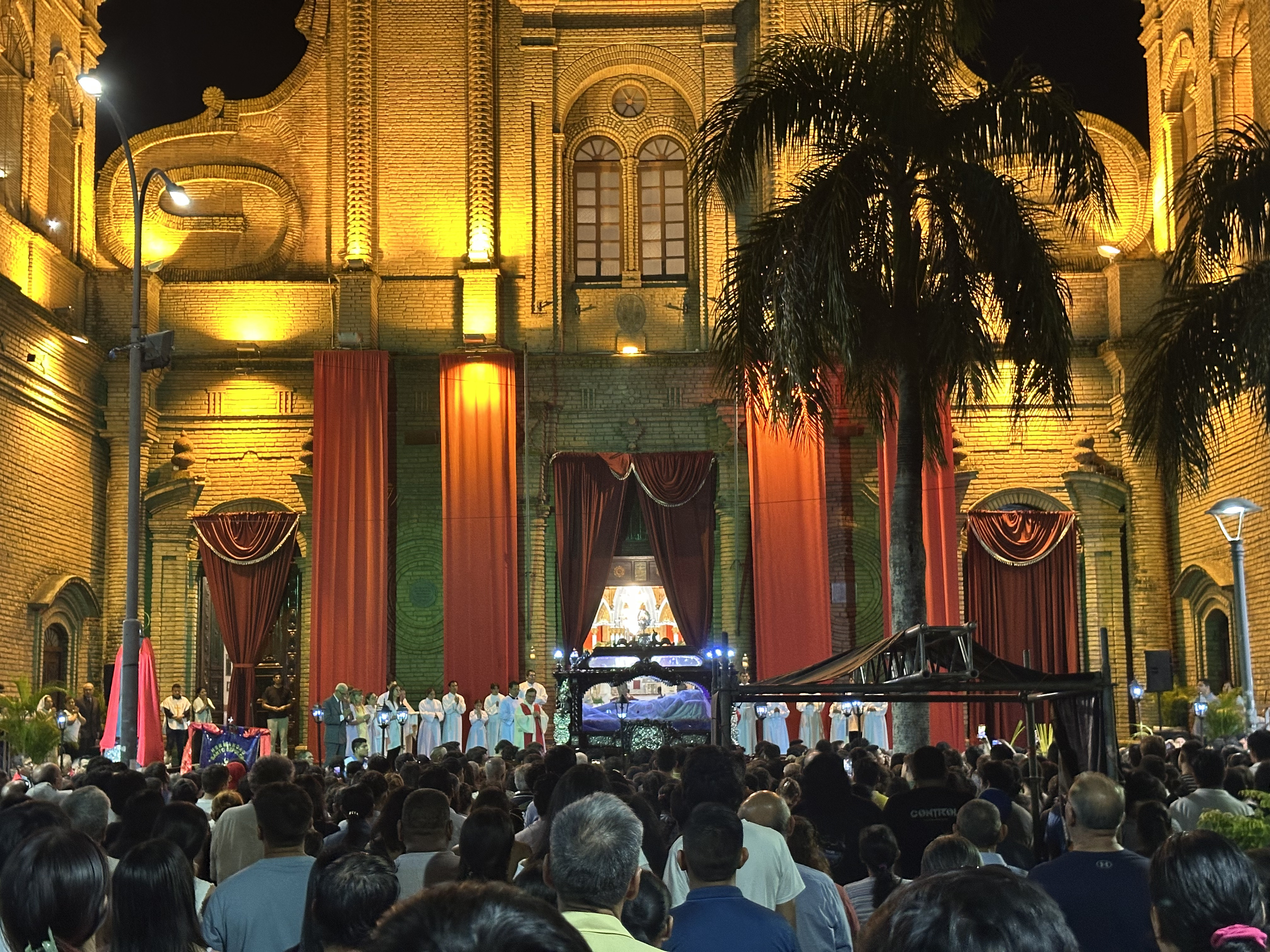
The candles start appearing on thursday night. In Sucre, the white colonial capital of Bolivia that most travelers miss, the processions begin around nine in the evening and do not really end until dawn on sunday. The faces are mostly old, but not only old. There are teenagers in the crowd who still know the words.
Latin America has many kinds of easter. There is the televised kind in the big cities of Brazil and Mexico, part religious event, part tourist spectacle. There is the private kind in the apartments of middle class families in Lima or Buenos Aires. And then there is the bolivian kind, which is the one that still feels like something is actually being mourned and celebrated and believed.
The Old Catholicism Meets Something Older
Bolivia's Holy Week is famously layered. The catholic observances were built on top of the andean calendar, and neither side ever fully agreed to share the stage. On Good Friday in the valley towns, people carry out the body of Christ, but they also bring offerings of coca leaves and chicha for the Pachamama. If a priest tells you one or the other is wrong, you are probably hearing the opinion of someone who is new here.
The most intense processions happen in the small towns. Tarabuco, Copacabana, Potosi. You can feel the pilgrimage on the roads. Trucks full of people standing in the open air, waving palms, carrying statues wrapped in plastic from the rain. It looks like a scene that belongs to an earlier century, except that the people in it have cell phones and credit cards and lives online.
What It Teaches the Visitor
If you travel through Bolivia during Holy Week expecting a quaint exotic show, you will be uncomfortable by sunday. This is not a performance. It is the visible part of something most of the modern world has decided to put away. Watching it, you realize how much of your own life is built on the assumption that belief is a private embarrassment rather than a public architecture.
Bolivia has not yet made that decision. You can see it in the candles. You can hear it in the silences between the psalms.
The Point of Still Going
A person does not have to be catholic, or religious at all, to feel something in the streets of Sucre at four in the morning on Easter Sunday. What you are feeling is the presence of a culture that still knows how to pause. That pause is increasingly rare. It is worth flying a long way to see.