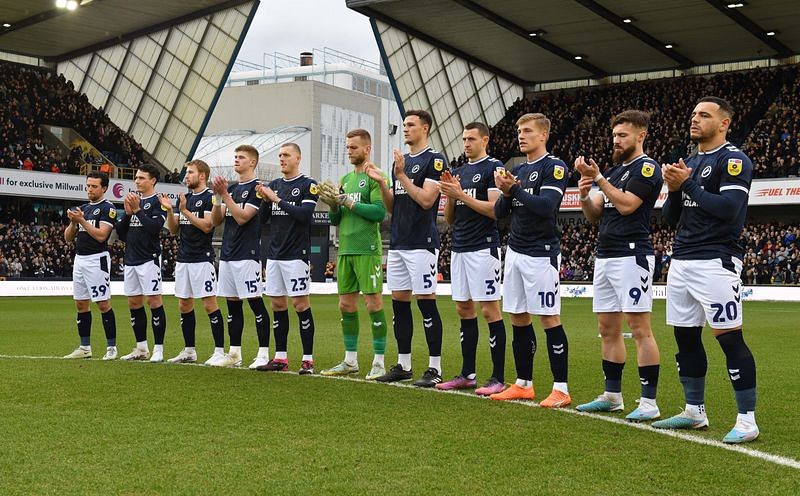
There is a specific moment at the Den, around the eighty fifth minute of a home match under floodlights, when the Cold Blow Lane end starts to move in a way no other stadium in England moves. The chant is the same one it has always been, the same three words every football fan in the world recognizes whether they want to or not. What is different in 2026 is the reason the chant is being sung. For the first time in years, Millwall is not singing in defiance. Millwall is singing in anticipation.
Something is happening in SE16.
The Club Nobody Wanted
Millwall Football Club is the single most misunderstood institution in English football. Founded in 1885 by the workers of a dockside jam factory on the Isle of Dogs, it moved across the Thames to south London and has been there ever since, never quite comfortable, never quite fashionable, never quite following any trend it did not pick for itself. For most of the last three decades it has been a Championship club with a reputation and a chip on its shoulder roughly the size of the Thames barrier.
The story of the club, as told by the rest of the country, has been the story of crowd trouble, of fences, of the 1985 FA Cup tie against Luton that ended up on the six o clock news. That story was never the whole story. It was the story that sold. It stuck.
What gets lost in that telling is the football. Millwall has produced England internationals, cup final appearances, and managerial careers that went on to win things in the top flight. The club is stubbornly local in a way that is almost extinct in modern English football. Its fans are born in the borough, raised on the ground, and they do not leave when things get bad. They double down.
What Changed
The current resurgence is not an accident and it is not a stroke of transfer luck. It is the quiet product of roughly four years of infrastructure work that nobody outside south London noticed. A new training ground. A youth academy that started producing players the first team could actually use. A recruitment department that stopped shopping for names and started shopping for fits. Ownership that, for once, decided not to interfere with the football people.
The result is a squad that is, on paper, not the most talented in the Championship, and in practice, close to the most effective. Millwall does not dominate possession. Millwall does not play the fashionable new high press. Millwall plays the way Millwall has always played, which is direct, physical, disciplined, and emotionally loud, except the modern version of Millwall is also young, technically literate, and coached by somebody who understands that the old style only works now if it is layered on top of new ideas.
It is not a revolution. It is a version of a very old idea, rebuilt with better parts.
The Business Side
The financial part of the comeback is the part most fans do not want to hear about and the part that makes the difference. Millwall's books are not pretty, but they are honest. The club did not spend the cheap money of the parachute payment era. It did not leverage itself against fantasy promotion scenarios. It did what almost nobody else in the Championship did and it lived within its means.
That discipline meant the club was in a position, when the window opened in the winter of 2025, to do two or three clever signings without selling the soul of the wage structure. Those signings are now starting. They are starting because the dressing room they walked into had already been built to receive them.
In an era when half of the Championship is one transfer window away from administration, Millwall is a rare thing. A mid table club with a plan.
Why It Matters Beyond SE16
The Millwall comeback is a story worth watching if you care about football as a cultural object rather than as a league table. It is the story of a club that refused to optimize itself into something else. Most clubs, given the chance to rebrand, would take it. Most clubs, given foreign investment, would pivot to a cleaner identity. Millwall has been offered both, repeatedly, and it has always declined.
The club is allowed to be what it is. The fans are allowed to be who they are. The shirt is the same blue it has been since 1936. The chant is the same chant. And, this season, for the first time in a long time, the table is actually worth watching too.
If Millwall goes up, and the possibility is no longer hypothetical, the Premier League will briefly have to deal with a club that does not look or sound like the Premier League. That is worth every minute of television time it will get.
The Long View
The comeback, whatever shape it finally takes, is already the headline. Promotion would confirm it. Playoff heartbreak would delay it by a year. Neither outcome takes away from what has happened in the last four seasons at the ground on Cold Blow Lane, which is that a club nobody wanted has quietly become a club nobody can easily dismiss.
South London is used to being the forgotten part of the city. Millwall is used to being the forgotten part of south London. Something is shifting. If you are a football fan and you have not paid attention to the Den in a decade, now is the moment.