A chronicle from the continent where going to the stadium stopped being safe.
A dispatch from Asunción
The smoke reached the center circle before anyone understood what was happening. On Sunday afternoon at the Estadio Defensores del Chaco, the Paraguayan superclásico between Olimpia and Cerro Porteño had not yet turned thirty minutes old. The score was 0-0. Richard Ortiz had just been honored for his 500th match in Olimpia's shirt. Forty thousand people were in the stands. And then a firecracker, a cebollón, the kind that shakes windows three blocks away, detonated in the north end, where the visiting fans from Barrio Obrero had been placed.
Then another. Then another.
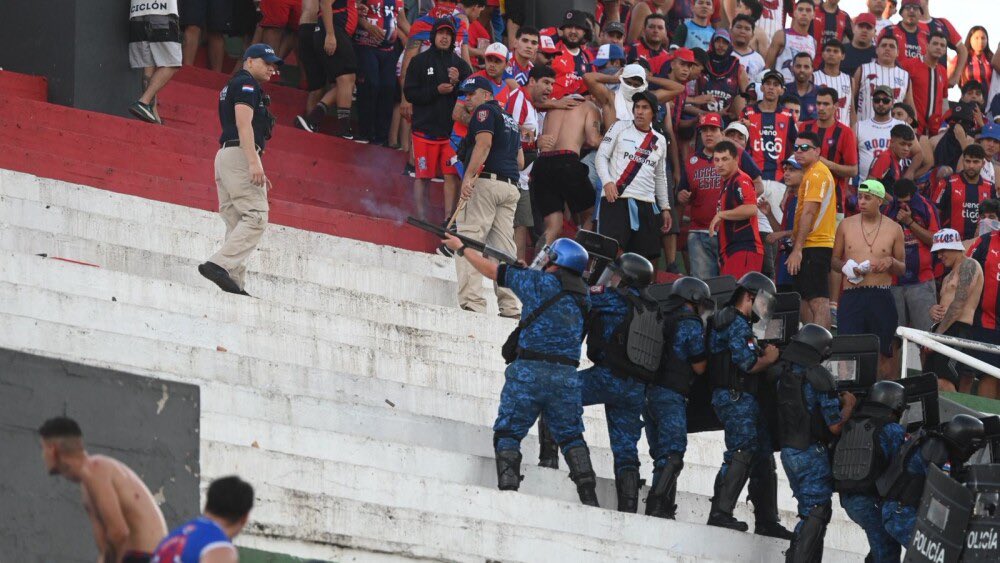
What followed in the next fifteen minutes has been replayed on Paraguayan television and X all night: riot police in blue helmets descending the stairs of the north stand, rubber bullets and tear gas fired point-blank into a crowd that included women and children, a policeman stripped of his shield as it was held aloft like a war trophy, one officer beaten to the ground and dragged by his own colleagues away from the blows, and, in a moment that will remain the strange, human footnote of a brutal afternoon, Olimpia fans from the opposing stand crossing the pitch to help Cerro fans escape the gas.
The referee, Juan Gabriel Benítez, stopped the match. Michel Sánchez, the Paraguayan Football Association's competition director, walked to the center of the field and said the words everyone already knew: "El partido queda suspendido. No existen las garantías mínimas para continuar." The match is suspended. There are no minimum guarantees to continue.
By the time the smoke cleared, six police officers had been hospitalized, one in critical condition, with head injuries and what doctors described as possible stab wounds. Around one hundred fans had been detained. Players from Cerro Porteño were throwing water bottles from the pitch into the stands, trying in improvised desperation to help the people choking on gas that had been fired by their own country's police.
This is the part where a certain kind of sports column would now quote a club president. We would rather tell you what Sunday in Asunción actually was: a planned, executed breach of one of the most heavily policed stadiums in the country, dressed as a clásico.
<blockquote class="twitter-tweet" data-media-max-width="560"><p lang="es" dir="ltr">🚨 AHORA | Gases lacrimógenos y balines en la gradería norte<br><br>Siguen los enfrentamientos entre la barra de <a href="https://twitter.com/hashtag/CerroPorte%C3%B1o?src=hash&ref_src=twsrc%5Etfw">#CerroPorteño</a> y los cascos azules.<br><br>Familias e hinchas intentan resguardarse en medio de los incidentes.<br><br>📌 Vía: <a href="https://twitter.com/ivanbo_10?ref_src=twsrc%5Etfw">@Ivanbo_10</a><a href="https://twitter.com/hashtag/LaGranJugada?src=hash&ref_src=twsrc%5Etfw">#LaGranJugada</a> <a href="https://t.co/ydFdivXglz">pic.twitter.com/ydFdivXglz</a></p>— Radio Ñandutí (@nanduti) <a href="https://twitter.com/nanduti/status/2045977647579099222?ref_src=twsrc%5Etfw">April 19, 2026</a></blockquote>
A premeditated event?
Call it what it looks like. The Paraguayan National Police deployed 3,500 officers for this match. They set up what they called the carpa azul, a blue tent outside the stadium where every ticket holder was supposed to be physically searched for firecrackers, knives, drugs, flags with poles, even umbrellas. The two main Cerro Porteño ultra groups, La Plaza and Comando Azulgrana, have been banned from entering stadiums for ten years, a sanction that runs until 2034. The only authorized Cerro supporters' group at the Defensores del Chaco on Sunday was Murga del Ciclón, and they were limited to twenty-six people.
And yet somewhere between the blue tent and the north stand, industrial-grade firecrackers made it into the ground.
A witness interviewed by Última Hora described what happened next with the clarity of someone who has seen this before: fans who had smuggled in the devices "began detonating them one by one" from the top of the north stand. The blasts brought the police down the stairs. And when the police reached them, the violence that followed had the choreography of something that had been rehearsed. A group tore the shield off an officer and held it up. Another group engaged the line in hand-to-hand combat. One officer ended up on the ground unconscious, beaten until colleagues and, the footage is clear on this, some members of the Cerro barra itself pulled him out.
This was not a spontaneous brawl. The Paraguayan National Police said so in writing on Sunday night, noting that what happened was "conducted by part of the Cerro Porteño fan base," and that officers are "working to identify those who started the conflict." By Monday morning, the Public Prosecutor's Office had six people in custody and was investigating charges that include disruption of public peace, resistance, and attempted grievous bodily harm, a charge that carries real prison time in Paraguay.
The word infiltration has been used in the local press, and it is the right word. What Paraguay saw on Sunday was the signature of groups whose entire purpose inside a stadium is no longer to cheer. It is to stage a spectacle of force. To film it. To post it. To win whatever internal hierarchy they are playing.
Blas Reguera, president of Cerro Porteño, told reporters it was "not the moment to discuss the three points at stake" and deflected responsibility to Olimpia as the home club. Rodrigo Nogués, president of Olimpia, said his club would "assert its rights" before the Tribunal of Discipline to have the points awarded. Neither man, on Sunday night, was talking about the police officer in critical condition.
<blockquote class="twitter-tweet" data-media-max-width="560"><p lang="es" dir="ltr">De esta manera los hinchas de <a href="https://twitter.com/hashtag/CerroPorte%C3%B1o?src=hash&ref_src=twsrc%5Etfw">#CerroPorteño</a> intentaron ingresar a Plateas, más imágenes de los lamentables hechos ocurridos hoy. <a href="https://twitter.com/rockandpop955?ref_src=twsrc%5Etfw">@rockandpop955</a><a href="https://twitter.com/nanduti?ref_src=twsrc%5Etfw">@nanduti</a><a href="https://twitter.com/hashtag/LaGranJugada?src=hash&ref_src=twsrc%5Etfw">#LaGranJugada</a> <a href="https://t.co/17D7QaiylM">pic.twitter.com/17D7QaiylM</a></p>— Bruno Pont (@BrunoPont) <a href="https://twitter.com/BrunoPont/status/2046018897615147184?ref_src=twsrc%5Etfw">April 20, 2026</a></blockquote>
Recent similar incidents in Paraguay
This did not come out of nowhere. Exactly one month ago, on March 20, the professional squad of Sportivo Luqueño was training at a field in Luque when men arrived in two motorcycles and a red pickup. They got off carrying industrial fireworks and began launching them directly at the players and coaching staff. The attack lasted about ten minutes. A club statement called it "systematic." The striker Jonathan Ramos, 18 years old, was struck and ended up with cuts to his leg, requiring hospital treatment.
These were Luqueño's own fans, attacking their own players.
In the days that followed, three ringleaders were identified: Hugo Iván Franco Mora (Huguito), 25; José Domingo Ramírez Meza (Negro), 27; and Jorge Daniel Céspedes Verón (Gordo), 23. A Hyundai Tucson in maroon, visible in video of the attack, was recovered. Franco was charged with creating common danger, grievous bodily harm, and violation of the law on the eradication of violence in sport. A judge put him in preventive detention. One week later, the same judge, Nelson Romero, released him to house arrest. The Paraguayan Football Association imposed a preventive measure: Luqueño's organized bars were banned from attending the team's next home match, and the north and south ends of the Luis Salinas stadium were closed.
That was March. This is April. The Cerro barra, already banned for ten years, got into the country's most important match anyway. Olimpia had faced its own flashpoint just weeks earlier, when a Guaraní-Olimpia classic in Capiatá produced an on-pitch brawl. Cerro fans and Sportivo Luqueño fans had a street skirmish outside La Nueva Olla in late March, about thirty people pouring out of a public bus with rocks, three arrests, a damaged police vehicle, an injured officer.
The pattern is visible if you step back. Paraguayan football is producing an incident of serious fan violence roughly every three to four weeks, at training grounds, on the streets outside stadiums, and now in the main show itself.
Chile and Mexico
The problem is regional, and the shape is the same everywhere.
In Santiago de Chile, the 2026 season of the Primera División opened on January 31 with Universidad de Chile hosting Audax Italiano at the Estadio Nacional. More than 3,000 U fans had been sanctioned by the Chilean football authority (ANFP) for incidents the previous season. Their most radical faction, Los de Abajo, announced on social media that they would boycott and bring incidents. They kept the promise. At minute 54, the south end of the stadium was on fire, fans tearing out seats and burning them in several fires that produced columns of black smoke over the pitch. The referee suspended play for eight minutes. Families with children abandoned the stadium during the halftime break. Four people were arrested.
That was the Chilean season opener.
Five months earlier, in August 2025, the same club had provoked an even worse incident in Argentina. During a Copa Sudamericana round-of-16 match at the Estadio Libertadores de América in Avellaneda against Independiente, Universidad de Chile fans in an upper tier rained down projectiles, bottles, rubble, chunks of toilets, seats, onto Independiente fans below. A noise bomb was fired into the home crowd. When the away end was mostly empty, Independiente ultras stormed it and cornered the last remaining Chilean fans, beating them, stripping them, and, on footage that circulated globally, forcing at least one to jump from a high tier. The match was cancelled. CONMEBOL eliminated Universidad de Chile from the tournament, fined both clubs, and imposed 14 closed-door matches in South American competition. Chile's Ley de Violencia en los Estadios, in place for three decades, is widely described by experts as insufficient, a dormant framework that produced almost zero prosecutions in its first years of existence.
A former Carabineros colonel, Pedro Valdivia, put the diagnosis in writing for El Mostrador in February: the hard core of the Chilean barras are no longer football fans who occasionally break things. They are professional criminals whose daily work is burglary, carjacking and assault. "The delinquent who goes to the stadium is the same one who later does a carjacking or a robbery. That's his profession," Rodrigo Goldberg, former sporting director of Universidad de Chile, told the same outlet. The barras are not a football problem anymore. They are a public-security problem that occasionally shows up at football matches.
Mexico has a more specific and more famous scar. On March 5, 2022, at the Estadio Corregidora in Querétaro, a match between the home side and Atlas descended in the 60th minute into one of the ugliest scenes ever broadcast from a Latin American stadium. Fans of both clubs beat each other with chairs, belts, metal bars, and their hands. Families ran onto the pitch for refuge. Men were stripped, dragged, kicked while unconscious. The official toll was 26 injured, 3 critically; 76 detentions. Querétaro played a year behind closed doors. The ownership group was ordered to sell the club. Visiting ultras were banned across Liga MX. A Fan ID system was introduced.
Four years later, much of that has been quietly rolled back. Visiting fans are allowed back in. Ownership of Querétaro was never successfully transferred. The Fan ID platform's servers routinely fail, creating chaos at stadium entrances. And in December 2024, during an América, Cruz Azul match at the Ciudad de los Deportes, the draw "moved to the stands", the language of a Mexican congressional document from April 2025 that now cites the Corregidora tragedy as the first in a chain of similar events through 2024.
Going to the stadium stopped being safe
For most of the twentieth century, going to the stadium in Latin America was the cheapest public event a family had access to. You took the bus. You took the kids. You took a thermos of tereré or mate. You sat on concrete. You yelled. You went home. On Sunday at the Defensores del Chaco, among the 40,000 people, there were mothers holding children who had to climb the wire dividers between stands to escape a cloud of tear gas fired by their own police, into a stand whose occupants were being shot with rubber bullets. This is no longer the same event.
It is worth stating this clearly: the percentage of people inside any South American stadium who came to cause violence on Sunday is small. Nearly everyone in the north end of the Defensores del Chaco was there to watch a football match. The problem is that the small percentage has become a professional class. They operate inside a broader economy, ticket resale, stadium concessions, merchandise, in some cases drug distribution. They are tolerated by some clubs because they provide an atmosphere that sells television rights. They are under-prosecuted because the laws against them are weak, the political cost of applying them is high, and in several countries the barras themselves have political protection.
What happened in Asunción on Sunday is what happens when that equation is left alone long enough. Three thousand five hundred police, a sanction until 2034, a physical search tent at every gate, none of it was enough. A firecracker got through. The policeman in the hospital this morning is real. The child who climbed the wire is real. The woman choking on gas is real.
The match was stopped. The tribunal will assign the three points. Olimpia will likely be awarded a 3-0 win. Cerro will argue the home team was responsible for security. The league will issue a statement. A new measure will be announced. Somewhere in the country, a thirty-five-year-old with a banned-for-life order until 2034 is already planning how to smuggle the next cebollón into the next match.
And this is the strange case. Not that violence exists in South American football. Violence has always existed in South American football. The strange case is that after Querétaro, after Avellaneda, after Luque, after Santiago, after every commission and every ministerial statement and every Fan ID platform, the perpetrators still walk in. The state arrives at the door of the stadium and stops there. The clubs sign the communiqués and wait for the news cycle to move on.
The stands filled anyway on Sunday. That part, honestly, is the part that still surprises.
The Daily Nomad, Dispatches from the places where the news is still being written., Sources: ABC Color, Última Hora, Diario HOY, Infobae, La Nación (AR), El Mostrador, AFP, Fox Sports, ESPN, official communiqué from the Paraguayan National Police, Asociación Paraguaya de Fútbol, Public Prosecutor's Office of Paraguay, Mexican Chamber of Deputies (Gaceta Parlamentaria, April 9, 2025), ANFP.